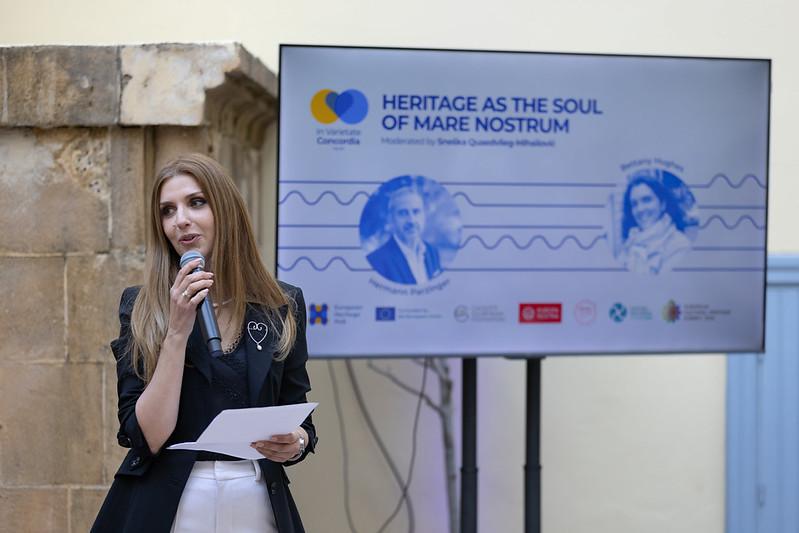
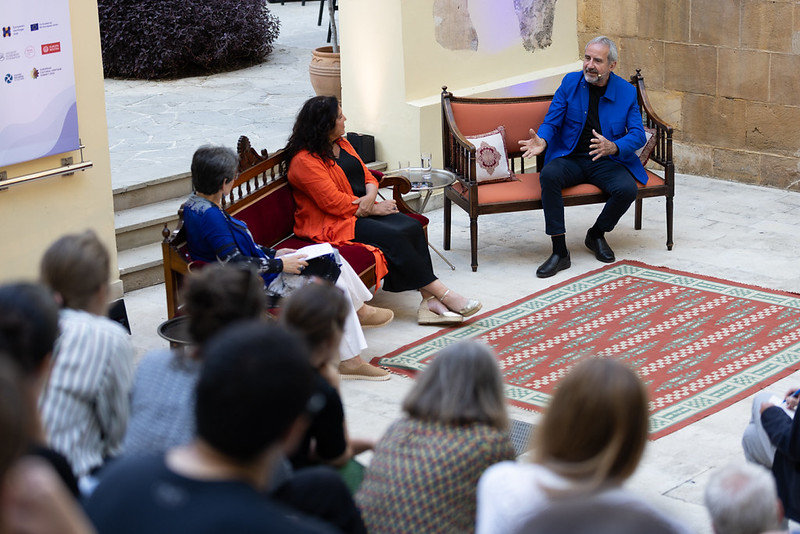
On 26 May 2026, the second In Varietate Concordia Talk, entitled “Heritage as the Soul of Mare Nostrum”, gathered award-winning historian, author and broadcaster Prof. Bettany Hughes and Prof. Dr. Hermann Parzinger, archaeologist and Executive President of Europa Nostra. Hosted in Nicosia, Europe’s last divided capital, the event drew on the panelists’ historical knowledge and touched upon themes of rising nationalism, misinformation and the destruction of cultural heritage, as well as hospitality, harmony, wonder, democracy, peace and shared memory.
The dialogue took place at the Leventis Municipal Museum of Nicosia, in the framework of the EU-funded European Heritage Hub and the European Cultural Heritage Summit 2026. Sneška Quaedvlieg-Mihailović, Secretary General of Europa Nostra and Project Leader of the European Heritage Hub, moderated the conversation.
Sneška Quaedvlieg-Mihailović opened the evening welcoming participants to the start of the European Cultural Heritage Summit 2026, co-organised with the European Heritage Hub in Nicosia. She wished Muslim colleagues a happy Kurban Bayram, one of the most important celebrations in the Islamic calendar, which coincided with the date of the Talk.
Tzeni Lymperopoulou, Director of the Leventis Municipal Museum of Nicosia, reflected on the unique role of the museum in preserving the memory of a city “with a long and layered past” whose history remains visible in everyday life. “Cultural heritage is not only about preserving the past,” she noted, “but encourages the understanding of the present.”
The Leventis Municipal Museum is a European Heritage Award 2026 laureate for its initiative Sector 2: Nicosia – The Green Line Project.
A Mediterranean of exchanges, encounters and connections
Throughout the evening, the speakers returned repeatedly to the Mediterranean as a space shaped by mobility, exchange, and coexistence.
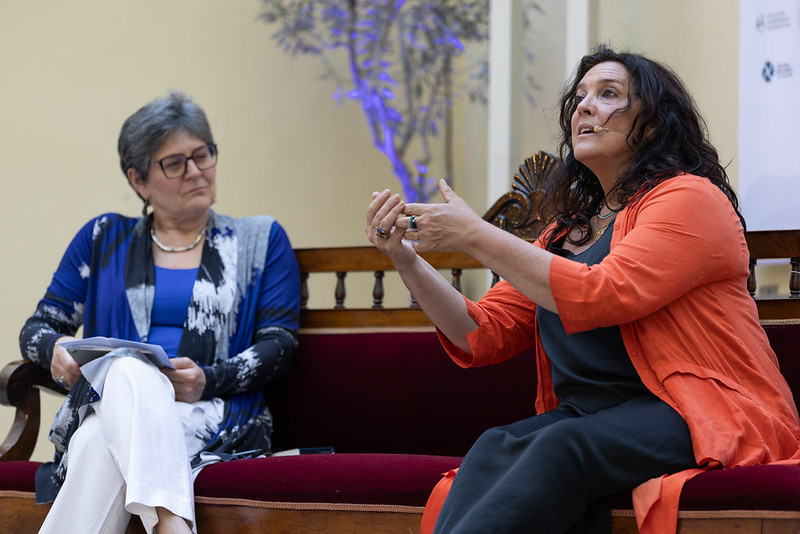
Drawing on the mythology of Aphrodite, born from the sea on the shores of Cyprus, Bettany Hughes reflected on the symbolic power of the island and its relevance for Europe today. Aphrodite, she argued, should not only be seen as the goddess of love, but also embodying harmony and the dynamic encounter of cultures and ideas across the Mediterranean. “Harmony is not just about a bland sameness,” Hughes remarked. “It’s the concord of difference.”
For Bettany Hughes, archaeology constantly reminds us that civilisation itself emerged through movement, encounters and exchange. “We should be called homo ambulans,” rather than homo sapiens, she said. “We’re constantly walking around.”
Prof. Dr. Hermann Parzinger likewise stressed that European history cannot be understood in isolation from the Mediterranean world. Tracing connections from the Neolithic period through the Bronze Age, he highlighted Cyprus’ central role in the gradual formation of Mare Nostrum, particularly through maritime trade and the circulation of knowledge, technologies, and peoples.
“Thanks to paleogenetic research, we know that it is migration that brought these influences and knowledge around,” Parzinger explained. “Knowing how interconnected we are is important to understand and respect.”
Heritage, democracy and the dangers of simplified histories
The discussion also addressed the challenges posed by nationalism, disinformation, and the politicisation of history. Responding to a question on whether Europe is “doomed for discordia”, Bettany Hughes cautioned against narratives of fatalism and collapse. Historians and archaeologists, she noted, know well that every generation believes itself to be living through unprecedented crises.
Hermann Parzinger warned against ideological distortions of the past and stressed the responsibility of scientific institutions to defend independent and objective research. “History was never simple,” he said. “If people tell you it in a simple version, be careful and be suspicious.”
Referring to the destruction and manipulation of cultural heritage during World War II and in present-day conflicts, including Ukraine, he emphasised that attacks on heritage reveal precisely how powerful culture can be. “You only destroy something if it’s powerful,” Bettany Hughes added.
Hospitality, civil society and the future of Europe
The conversation also turned to the enduring importance of hospitality, cooperation, and civil society in sustaining democratic culture.
Recalling the ancient concept of ghosti — the linguistic root of the English word “guest” — Bettany Hughes described hospitality as one of the foundational principles of civilisation itself: the willingness to welcome strangers rather than fear them.
Both speakers stressed that cultural cooperation across borders remains one of the strongest antidotes to division and extremism. “Do not underestimate the power of culture,” Hermann Parzinger urged. “There is nothing uniting more than people from different countries doing research together about culture.”
Nearing the end of the conversation, multiple participants from the audience were invited to join the discussion: Androulla Vassiliou, Leader of the European Heritage Hub in Nicosia, Jimmy Jamar, Executive Vice-President of Europa Nostra, Koen van Balen, Professor Emeritus at KU Leuven, and Amra Hadžimuhamedović, Director of the Centre for Cultural Heritage, International Forum Bosnia.
The evening concluded with the panelists’ final reflections on democracy, solidarity, and hope. “Democracy is probably our most endangered heritage,” Bettany Hughes and Hermann Parzinger agreed, underlining the importance of education, cultural participation, and civic engagement.
Closing the discussion, Sneška Quaedvlieg-Mihailović brought the conversation back to Nicosia itself — “a city with so many layers and cultures” situated only minutes away from the Green Line and buffer zone. In this symbolic setting, she stressed the importance of dialogue, solidarity, and continued investment in civil society across the Mediterranean region.
About In Varietate Concordia
The In Varietate Concordia initiative, launched by the EU-funded European Heritage Hub and coordinated by Europa Nostra and the Centro Nacional de Cultura with the support of the Calouste Gulbenkian Foundation, seeks to promote precisely this spirit of exchange and reflection. Inspired by the European Union’s motto “United in Diversity”, the initiative fosters conversations, podcasts, and opinion pieces that defend Europe’s fundamental values through culture and heritage.
Held under the motto “Heritage as the Soul of Mare Nostrum”, the European Cultural Heritage Summit 2026 continues in Nicosia until 30 May, highlighting the geopolitical, societal, environmental, and economic importance of cultural heritage for Europe and the wider Mediterranean region.