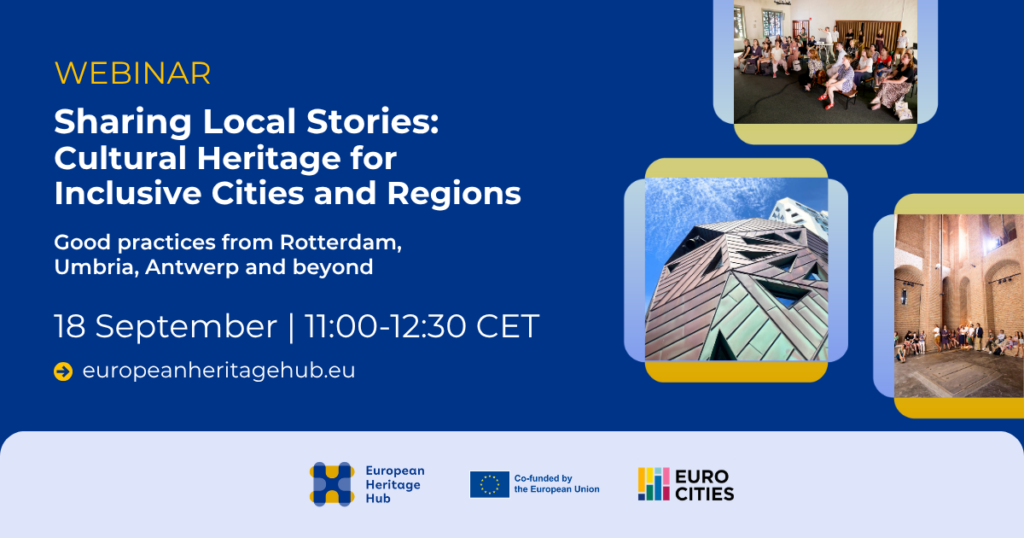
On 18 September, join the European Heritage Hub for the webinar “Sharing Local Stories: Cultural Heritage for Inclusive Cities and Regions”.
During this session, we will dive into the key lessons from our recent Peer-Learning Visit to Rotterdam from 18-20 June, and discover connected initiatives in other European cities and regions! You will get insights into the content of the visit, including recommendations for cities, regions and cultural heritage stakeholders, from the expert who facilitated the Peer-Learning programme. You will also learn about two case studies from the participating cultural heritage practitioners.
Speakers
- Tanja Mlaker, Director Cultuur Eindhoven (The Netherlands) – Hub Peer-Learning Visit expert
- Martijn van der Mark, City of Rotterdam (The Netherlands) – Hub Peer-Learning Visit host
- Greet Donckers, Cultural Heritage Consultant, City of Antwerp (Belgium)
- Gianluigi Bettin, Project Manager, Sviluppumbria – Regional agency of economic development in Umbria (Italy)
Case Study 1: Holy Houses and storytelling in Rotterdam
Rotterdam’s approach to religious heritage is rooted in a broader vision for urban development. The municipality works across protection and conservation, knowledge development, and communication and engagement. At the heart of this approach is Holy Houses (Heilige Huisjes, in Dutch), a city-wide network and festival that celebrates Rotterdam’s diverse religious heritage while exploring its future potential. Holy Houses offers an example of how cities can connect heritage, culture and community-building in ways that respond to contemporary urban challenges. Find out more about Holy Houses in the European Heritage Hub Local Good Practices Catalogue.
The Hub’s Peer-Learning Visit in Rotterdam also explored storytelling initiatives to pass on the memory of neighbourhoods and communities as the city transforms. Through unconventional guided tours, site visits, presentations and informal encounters, the visit highlighted the principle that successful heritage management depends on people, participation and purpose as much as on physical conservation.
Case Study 2: Cultural heritage in Antwerp
The heritage policy of the City of Antwerp puts preservation, adaptive reuse, public engagement, and participation at its core. The city focuses on sustainable heritage management, knowledge sharing, and collaboration with museums, archives, heritage organisations, associations, and residents. Heritage is not only protected but also actively made accessible and used as a lever for education, identity, and social engagement.
Antwerp faces contemporary challenges such as rapid urban development and densification, which create pressure that requires careful balancing between heritage conservation and renewal. Climate change poses a growing threat to historic assets, while the city’s diverse context calls for an inclusive and representative approach to heritage. In response, the city increasingly invests in participation, co-creation, digitalisation, and awareness-raising to ensure that heritage remains relevant and accessible to diverse audiences and future generations.
Case Study 3: Walking-route tourism in Umbria
Since 2008, the Umbria region has identified walking-route tourism as an important driver of sustainable tourism development, especially in peripheral areas. The success of walking routes — and their positive economic and social impact — is based on the involvement and participation of local communities (civil and religious associations, private operators, local public bodies) through participatory decision-making in both planning and monitoring.
In 2025, the association “Vie e Cammini di Francesco” was established by the Ministry of Tourism, the Ministry of Culture, and four Italian Regions, with a steering committee composed of religious representatives. Umbria’s new Regional Tourism Law (No. 23/2024) sets a legislative framework that defines quality standards for slow, experiential, and inclusive tourism, while “Observatory for Slow Tourism,” oversees research to ensure that spiritual routes meet rigorous criteria for accessibility, professional training, and sustainability. On a national level, the “Cammini Aperti” initiative, Italy’s largest event dedicated to walking trails, involves a partnership between ministries, regions and numerous stakeholders to promote cultural and natural paths, addressing the most pressing challenges in contemporary heritage management.
The session will provide an occasion to engage in discussion with peers from other European local authorities and cultural heritage professionals. The organisers will provide access to the materials shared during the Peer-Learning Visit.