Sarajevo, the capital of Bosnia and Herzegovina, rests nestled between mountains, shaped by the Miljacka River. Its rich past is marked by significant historical thresholds across all eras, from prehistory to contemporary times. Through every transition – from being part of three Empires to the modern state, from occupation to independence, from conflict to recovery – Sarajevo has remained a city of cultural, religious, and ethnic diversity.
In this setting, the European Heritage Hub hosted a three-day peer learning visit, bringing together 19 professionals from 12 different countries including Armenia, Georgia, Serbia, and Ukraine, to explore how Sarajevo uses cultural heritage to heal, rebuild, and imagine a better future.
Through site visits, panel discussions, and conversations, participants explored how culture can help cities recover from conflict, shape more inclusive societies, and respond to today’s urgent challenges.
Cultural plurality and urban landscape
The first part of the visit aimed at acquainting participants to the specific cultural and urban landscape in Sarajevo. Guided by expert Amra Hadžimuhamedović, Director of the Centre for Cultural Heritage, International Forum Bosnia, and Boris Trapara, Director of the Cantonal Institute for the Protection of Cultural, Historical, and Natural Heritage, a key professional institution responsible for the preservation and protection of heritage in the Federation of Bosnia and Herzegovina.
Sarajevo is a city shaped by many cultures, histories, and identities where mosques, churches, and synagogues stand side by side, and where every building, street, and courtyard seems to hold a story. Walking through the city is like moving through time. Within a few steps, you might pass an Ottoman-era mosque, a Catholic cathedral, a synagogue, a block from the Austro-Hungarian period or a post-modernist building. Sarajevo’s identity is rooted in its coexistence of cultures and religions. This pluralism, while once targeted for erasure during the longest siege in modern history, has become a foundation for resilience, as Mayor Predrag Puharić cited when opening the visit, “Heritage is not only a memory of the past but a bridge to the future.”
Visits to emblematic heritage houses such as the Svrzo House, an 18th-century Muslim family residence, and the Despić House, an ancient home to an Orthodox merchant family, demonstrated how domestic life, architecture, and hospitality traditions carry the marks of shared history and confluence of cultures.
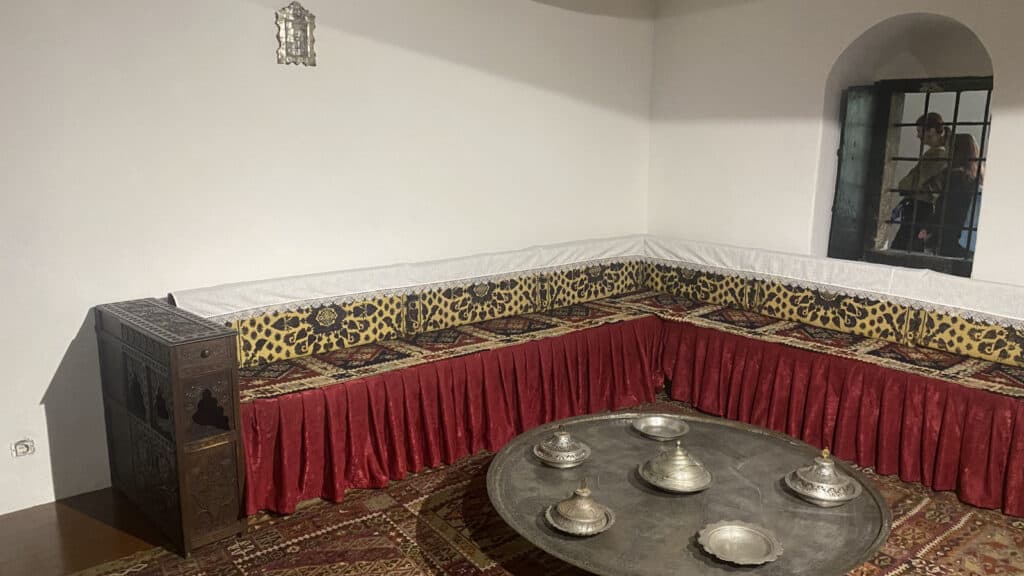
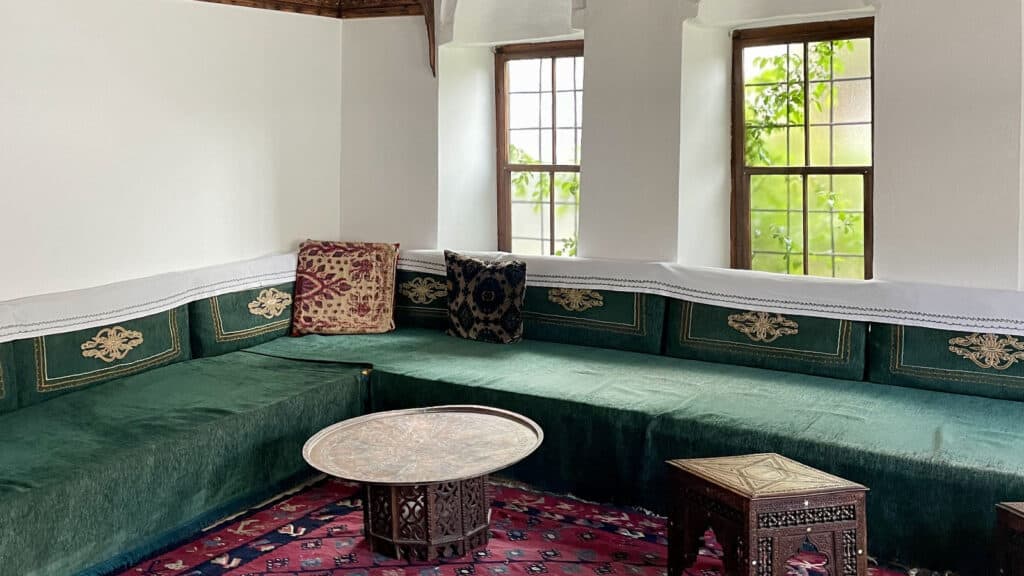
Photo credits: © Eurocities
Urbanisation during the Ottoman period shaped the city in close-knit neighbourhoods around basic services including a bakery and a mosque. Its location along the river, surrounded by green hills, immediately connects the city to its natural heritage.
Once known as a city of water, Sarajevo brings this heritage back to life in the backdrop of today’s concerns for more sustainable ways of living. The mapping of public drinking water fountains across the city won a New European Bauhaus award in 2024. Led by civil society and local authorities, the project maps and rehabilitates these once-essential, often community-built water sources. By bringing them back into everyday use, it fosters a sense of identity while turning overlooked heritage into a practical tool for environmental change; promoting public water access and reducing plastic waste.
Post-conflict heritage recovery
Sarajevo’s experience of war and siege (1992–1995), the destruction of cultural assets, the individual and collective trauma have deeply marked the city’s urban and cultural memory. Yet, recovery did not begin after the war, but during it. Creativity, solidarity, and resistance took form in cultural expressions that sought to preserve the identity of the city even under constant attack and laid the groundwork for post-war cultural renewal.
Learning about Sarajevo’s path to resilience began at the City Hall, Vijećnica, formerly the National Library and city archive, which was burned to the ground during the war, resulting in the loss of 3.5 million books. Reopened in 2013 in its original Orientalist style, it now stands as both a restored landmark and a powerful symbol of the city’s resilience. A similar story of post-war transformation was observed with the visit to the Faculty of Islamic Studies. Originally constructed in 1889 and destroyed during the conflict, it has been sensitively reconstructed and now forms part of the University of Sarajevo. Together, these projects exemplify adaptive reuse and the enduring role of cultural heritage in reclaiming a city’s identity.
One of the most moving features of Sarajevo’s post-conflict memory are the “Sarajevo Roses”, craters from shell explosions filled with red resin to mark the sites where civilians were killed. Though understated and often unofficial, they act as powerful reminders embedded in the city’s streets. As a participant reflected: “It became clear that grassroots actions and creative expressions emerging from the population can address complex societal issues.”
Other presented artistic projects included the installation of 12,000 red chairs in honour of civilian casualties accompanied by a concert, the participatory artwork “Why Are You Not There?”, created to mark the Srebrenica genocide, using coffee cups symbolising Bosnia’s daily rituals to remember the missing. In “My Family Garden”, a young artist invited citizens to plant calendula on former trenches, recognising trauma not only within people, but in the land itself. These reflections highlight how art and heritage serve as means to healing trauma. From bullet-ridden walls to modern art installations, Sarajevo’s public space reflects the scars of war and its determination to preserve, not erase, those memories.
Community engagement in heritage and participatory museology
Community involvement emerged as a central theme throughout the visit. Sarajevo has developed a powerful network of community-led museums and participatory initiatives that ensure recovery remains a shared process.
The War Childhood Museum, the Olympic Museum, and the Historical Museum of Bosnia and Herzegovina were presented as leading examples of community museology. These institutions rely heavily on public donations and thus engage citizens in co-creating historical narratives.
“Markers of war memory in public space change and shape collective memory. Each historical era leaves its mark on architecture, life, and customs, but it is only social communities that determine which marks remain and are accepted by the community and which are rejected”, stated a participant from Ukraine.
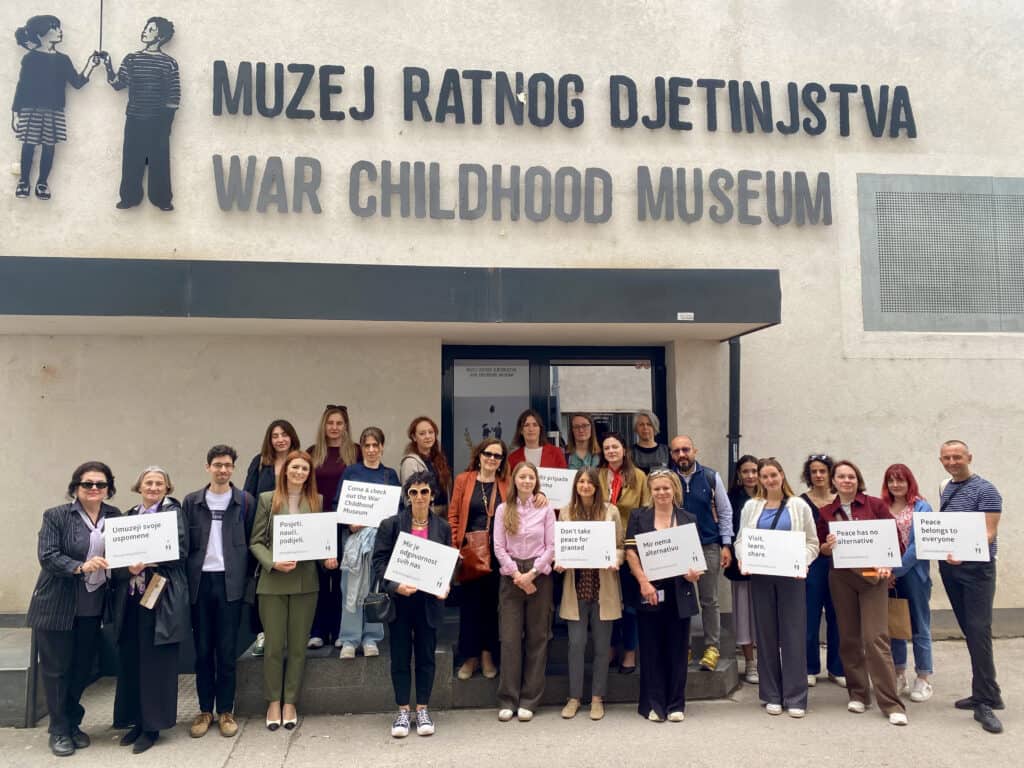
Photo credits: © Europa Nostra
Founded in 2017, the War Childhood Museum is unique in its focus on childhoods affected by war. Its core exhibition is built around everyday personal objects, each accompanied by a child’s testimony. To date, the museum has collected over 600 such stories and continues to grow, adding approximately 40 new contributions each year and refreshing its display annually. It operates on an open-contribution model, inviting anyone who experienced childhood during conflict to donate objects and share stories. The museum has expanded beyond Bosnia and Herzegovina, with documentation projects in Syria, Ukraine, and Palestine. In 2020, it opened an office in Kyiv, where over 200 stories from Ukrainian children have since been collected. The museum also runs educational workshops in schools, fostering storytelling, cultural awareness, and empathy among young people. During the COVID-19 pandemic, it adapted by offering online programming that addressed children’s mental health and emotional resilience.
New technologies are playing a key role in this forward-looking approach. A panel discussion on digital tools and participation showcased experiences from Boyarka, Ukraine, and Nantes, France, alongside Sarajevo city museums and regional networks. In Boyarka, youth-led initiatives like MolodSpace and the “New life for an old Dacha” project foster community resilience, while Nantes Patrimonia, a digital platform, enables citizens to share stories and co-author their heritage.
Heritage as healing: lessons from Sarajevo on resilience, recovery, and unity in diversity
The peer-learning visit showed how heritage can serve as a unifying force in post-conflict contexts, for rebuilding trust and creating space for dialogue, especially across generations and borders. For many participants, the visit was both professionally enriching and personally moving. It sparked reflection on how heritage practice must navigate what can be preserved alongside what has already been lost. Other participants described the experience as healing, offering new insights into how heritage can be used to foster resilience in the face of continued uncertainty. “Such visits foster professional growth, encourage collaboration, and contribute significantly to advancing heritage preservation and community engagement efforts.” commented a participant.
Sarajevo remains in an ongoing process of recovery that began during the war and continues to this day. While trauma is still present in the urban and social fabric, the city has developed tools to confront it, using cultural heritage as both a form of resistance to destruction and a means of renewal. Sarajevo’s cultural community actively looks ahead, grounded in strong civic participation and a commitment to inclusive future-oriented practices. The city’s layered heritage reflects the resilience of its people and continues to shape Sarajevo as a symbol of coexistence and a beacon of the European ideal: unity in diversity.